
I was an unusual teenager. While my peers were following the music and culture of what has now become one of the most iconic eras of all time, I was buried in music from decades earlier. I spent 1978 to 1981 exploring the work of Glenn Miller, but from the early eighties there were two men who became my absolute idols: Buddy Holly and Eddie Cochran.

Today, 7 September 2026, Buddy Holly would have been 90 years old had he not been tragically killed in a plane crash on 3 February 1959, aged only 22. But in the short time we had him, Buddy’s star shone so brightly, and it is still glowing now. I want to explore the influence of this remarkable young man who, through tragedy, will remain eternally young.
Buddy Holly really spoke to me. I was a shy, unconfident youth. His songs helped ease the pain of asking girls out and being rejected. He seemed to understand the awkwardness and heartache a young man had to go through as a rite of passage.
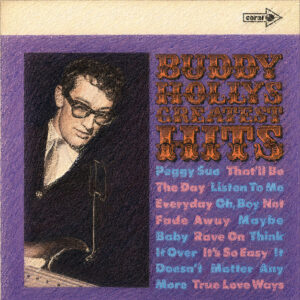
I first found him on a record, Buddy Holly’s Greatest Hits, tucked away in my parents’ collection. It was the sound that instantly hooked me: the rumbling drums on “Peggy Sue”, the strange beat of “Not Fade Away”, and the brilliant jangle of the Stratocaster on “That’ll Be the Day”.
I remember the sleeve notes making the point that the Buddy Holly sound of the fifties helped shape the British sound of the sixties. I would go further than that: his influence has reached across nearly seven decades. I believe every band with drums, guitar, bass and a songwriting singer owes something to Holly.
Of course, he did not create his sound in isolation. Rock and roll grew from deep roots in Black American rhythm and blues, alongside country and gospel. Great musicians such as Chuck Berry and Little Richard were huge influences on Holly. But his country vocal hiccups, phrasing and musical imagination helped make the resulting sound unmistakably his own.
Paul McCartney has often spoken about Holly’s importance to the Beatles. Here was someone who sang, wrote songs, played guitar and took the solos himself. That was a powerful example for young musicians to follow. As the Quarrymen, the group that became the Beatles, they recorded “That’ll Be the Day” in 1958. They went on to record “Words of Love” for Beatles for Sale. He was that important to them. McCartney’s company, MPL, would eventually acquire publishing rights to Holly’s song catalogue.
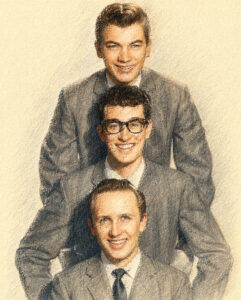
When I teach my pupils guitar, I always start with “That’ll Be the Day”. I also feel proud that, during their short touring career, Buddy Holly and the Crickets performed at the Globe in Stockton on Wednesday 5 March 1958, with a young Des O’Connor acting as compère. My friend Arthur Long was in the audience, and he has told me they were brilliant.
Buddy travelled through the same town, and along streets I drive along today. That helps me feel connected to him. I remember doing a gig at the Globe myself and saying to the lads in the band, “Just think, lads—Buddy Holly might have carried his gear in this way.”
For a moment, the years between us seemed a little smaller.
Apart from that crisp, distinctive recorded sound, I have always found his songwriting to be something very special. Holly was not confined to the familiar rock and roll formulas, although he certainly used them. “Love Me”, which he co-wrote with Sue Parrish, follows a twelve-bar blues structure, while “Peggy Sue” adds its own variations to that framework.
His recording of “Rock Around with Ollie Vee”, written by his early bandmate Sonny Curtis, captures the excitement of his rockabilly roots. “Last Night”, credited to Joe B. Mauldin and Norman Petty, uses the familiar I–vi–IV–V progression associated with doo-wop.
Holly always seemed to bring something fresh to the music: a vocal phrase, a rhythmic idea, a bridge or a solo that was just that bit more special. He explored different moods and textures in songs such as “Words of Love” and “Well… All Right”. His interpretation of “Heartbeat”, written by Bob Montgomery and Norman Petty, also showed how convincingly he could make another writer’s song his own.

He was the real deal, and I would have loved to know what he might have achieved had he lived beyond Twenty Two.
The true heartbreak of his death was the point in his short life at which it occurred. He had married the beautiful María Elena Santiago in August 1958, and they were expecting their first child. He was also beginning to explore a future beyond performing, taking an interest in producing other artists and developing his role in the music business.
His final studio session, in October 1958, produced the stunning orchestral recordings “Raining in My Heart”, “Moondreams”, “It Doesn’t Matter Anymore” and “True Love Ways”. The last of these is one of my all-time favourite love songs.
In less than two years after his first hit, Buddy Holly had shown what a complete artist he was. He has inspired me all my life.
His story did not end on that fateful night. Don McLean honoured him in “American Pie”, remembering the tragedy as “the day the music died”. But for those of us who love Buddy, the music never really stopped.
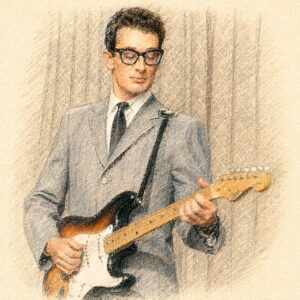
In late 1958 and January 1959, Holly used an Ampex tape recorder to record songwriting sketches and demos in his New York apartment. These recordings were later overdubbed and released, giving us a glimpse of the songs he was developing. The original home recordings let us hear something even more intimate: a young man with his guitar, still exploring where his music might take him.
I have loved Buddy Holly’s music from the moment I first heard it. I cried listening to the Royal Philharmonic Orchestra arrangements on True Love Ways, released in 2018. For me, an inner beauty in the music shone through those recordings.
I recently changed the scratchplate on my sunburst Strat to white, to make it look more like Holly’s. I now wear glasses, and they have to be a bit Holly-ish.
He is that important to me.
Tonight, I will be raising a glass to this complete legend and wishing him a happy heavenly 90th birthday.
Thank you for the music, Buddy.

Be the first to comment